
New CLMS global Land Surface Phenology products
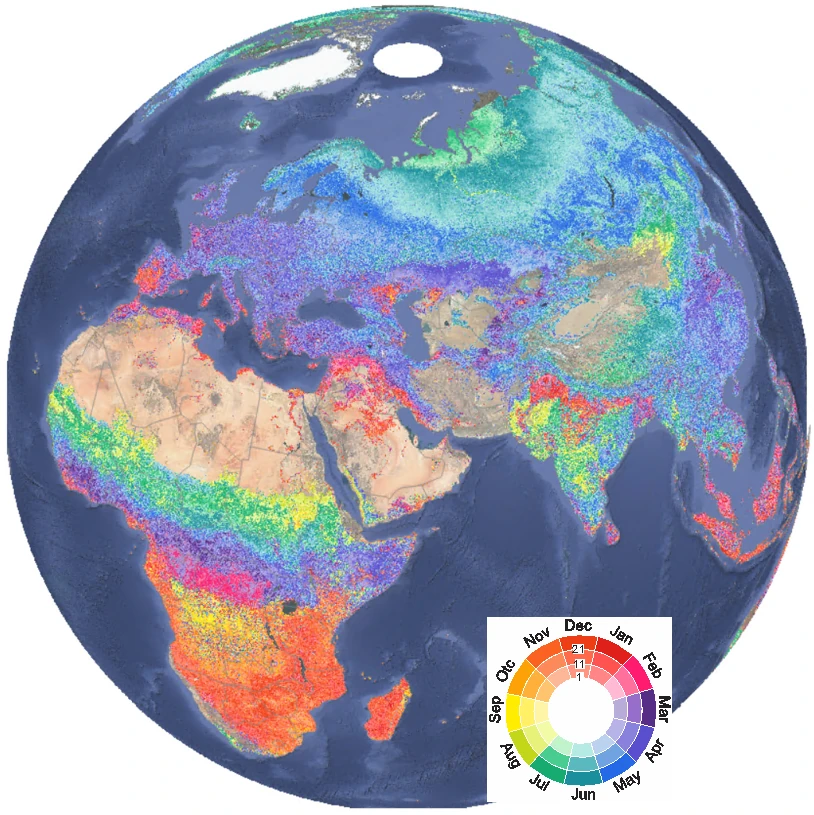
The Copernicus Land Monitoring Service has recently released global annual maps giving insight into sensitivity of seasonal vegetation dynamics to environmental conditions and extreme events. The Version 2 of Land Surface Phenology (LSP) products are derived from PROBA-V and Sentinel-3 OLCI data at 300m resolution. They currently cover 11 years from 2014 to 2024. The 2025 product will be available in March 2026.

In the context of its land monitoring activities, HYGEOS has coordinated the work between experts from Lund University who have developed the products,  VITO that operates the processing chain and EOLAB that performs the independent validation.

Phenology is defined as the biological phases that recur periodically and their relationships to climate variability and change. The CLMS LSP product describes these seasonal growth patterns of vegetated land surface. It gathers 13 phenological and productivity metrics like the start, maximum and end dates of growing season, with quality indicators. Recognized by the Intergovernmental Panel on Climate Change as key indicator of climate change impacts on terrestrial ecosystems, phenology is also one of the Essential Biodiversity Variables observable from space. Plant phenology regulates land surface carbon, water, and energy balance, making LSP central to climate change assessment, drought monitoring, agricultural management, and ecosystem services and functioning.

Start Of Season Date 2024 of Land Surface Phenology products V2

Start of Season Date, 2024

The CLMS LSP V2 supports a wide range of operational applications. Phenology metrics contribute to land cover change assessment, forest disturbance and dynamics mapping, and ecosystem resilience studies. Phenology information helps optimize agricultural practices, predict yield potential, and strengthen food-security assessments. Phenology anomalies provide indicators for water stress impacts on vegetation, supporting drought assessment and mitigation planning. Variations in phenology reveal ecosystem responses to climate change and environmental stressors, informing effective conservation strategies and habitat management. For research purposes, phenology provides benchmark seasonality for calibration of dynamic vegetation models.
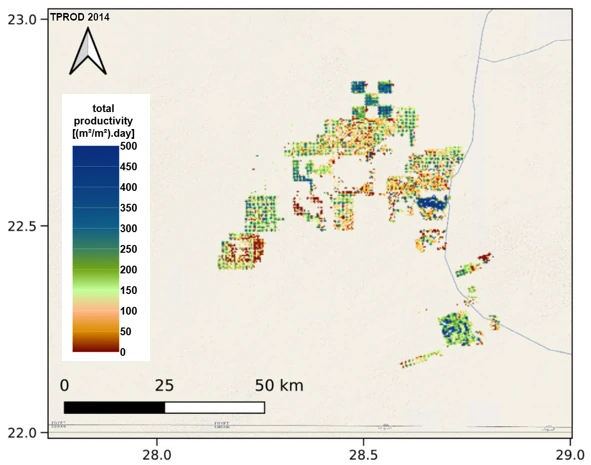
Total Productivity 2014 over Egypt as given in Land Surface Phenology V2
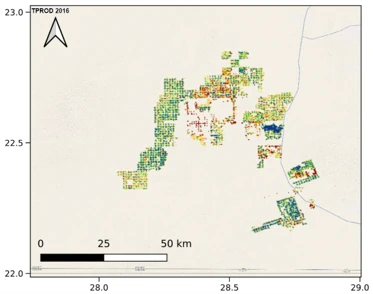
Total Productivity 2016 over Egypt as given in Land Surface Phenology V2
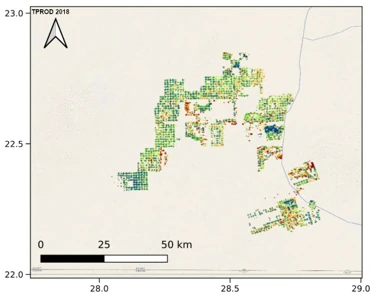
Total Productivity 2018 over Egypt as given in Land Surface Phenology V2
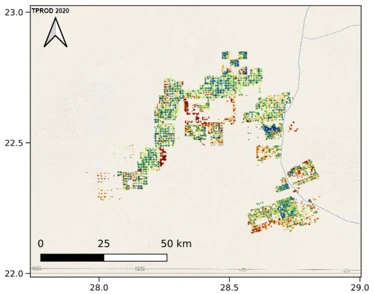
Total Productivity 2020 over Egypt as given in Land Surface Phenology V2
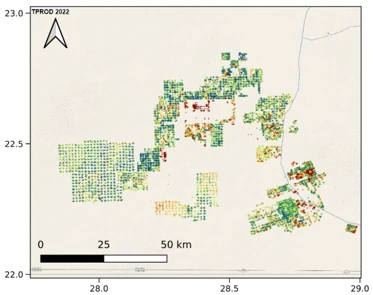
Total Productivity 2022 over Egypt as given in Land Surface Phenology V2
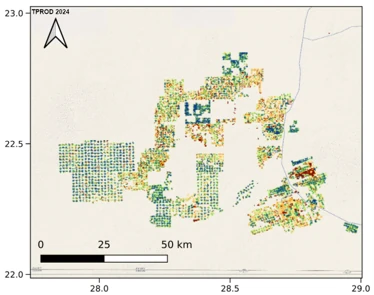
Total Productivity 2024 over Egypt as given in Land Surface Phenology V2

Total Productivity, Season 1, for 2014, 2016, 2018 (top), 2020, 2022 and 2024 (bottom) over Egypt.

The products have passed an exhaustive validation procedure using thousands of independent in situ observations from 4 phenological networks around the world. The CLMS LSP V2 products are an accurate, robust, consistent dataset. They are delivered with a complete documentation including the ATBD, a Product User Manual and the Validation Report. The products are accessible through the download options of the Copernicus Data Space Ecosystem (CDSE). They are also viewable through the CDSE browser.

The activity has been funded by the European Commission under a contract with the Joint Research Center.