
IASI-PCA: detection of extreme atmospheric events
Processing the large volume of IASI data is challenging. Exploiting the potential of IASI for monitoring extreme events therefore requires the development of automated methods. HYGEOS and SPASCIA have investigated the application of Principal Component Analysis on atmospheric spectra to identify extreme events. These latter are defined as data outliers relative to the natural variability of the atmosphere. The novelty is to take advantage of PCA ability to target reconstruction anomalies arising from unusual spectral features in the original measurements, which can be associated with rare or extreme events. The objective is to detect quickly anomalous spectral signatures associated with some trace gases (CO, CO2, NH3, SO2, volatile organic compounds including C2H2, C2H4, CH3OH, HCOOH, HCN) and one carbonate mineral (calcite CaCO3).
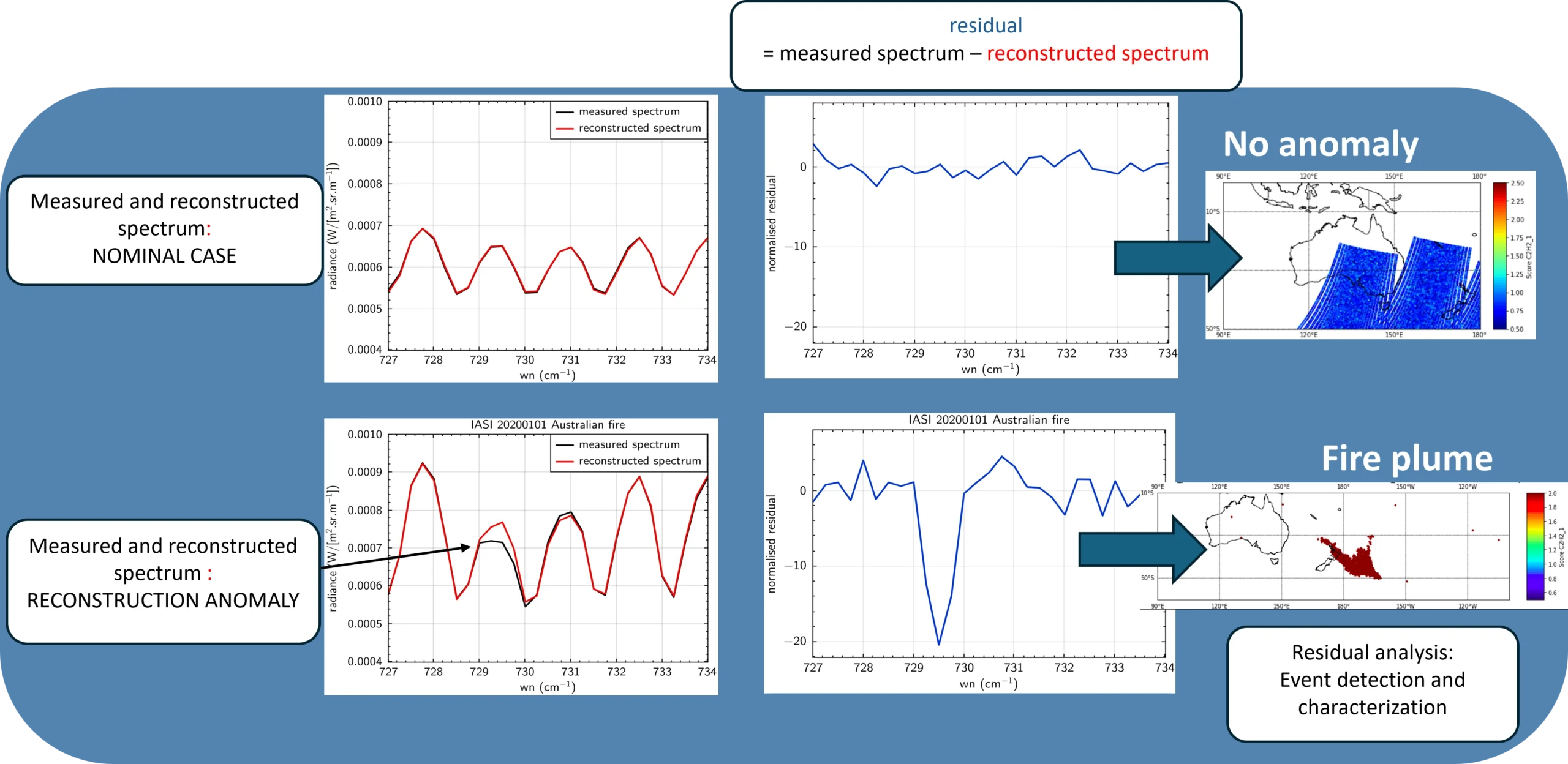
IASI-PCA methodology to detect extreme atmospheric events
Now a near-real-time operational software, not just research
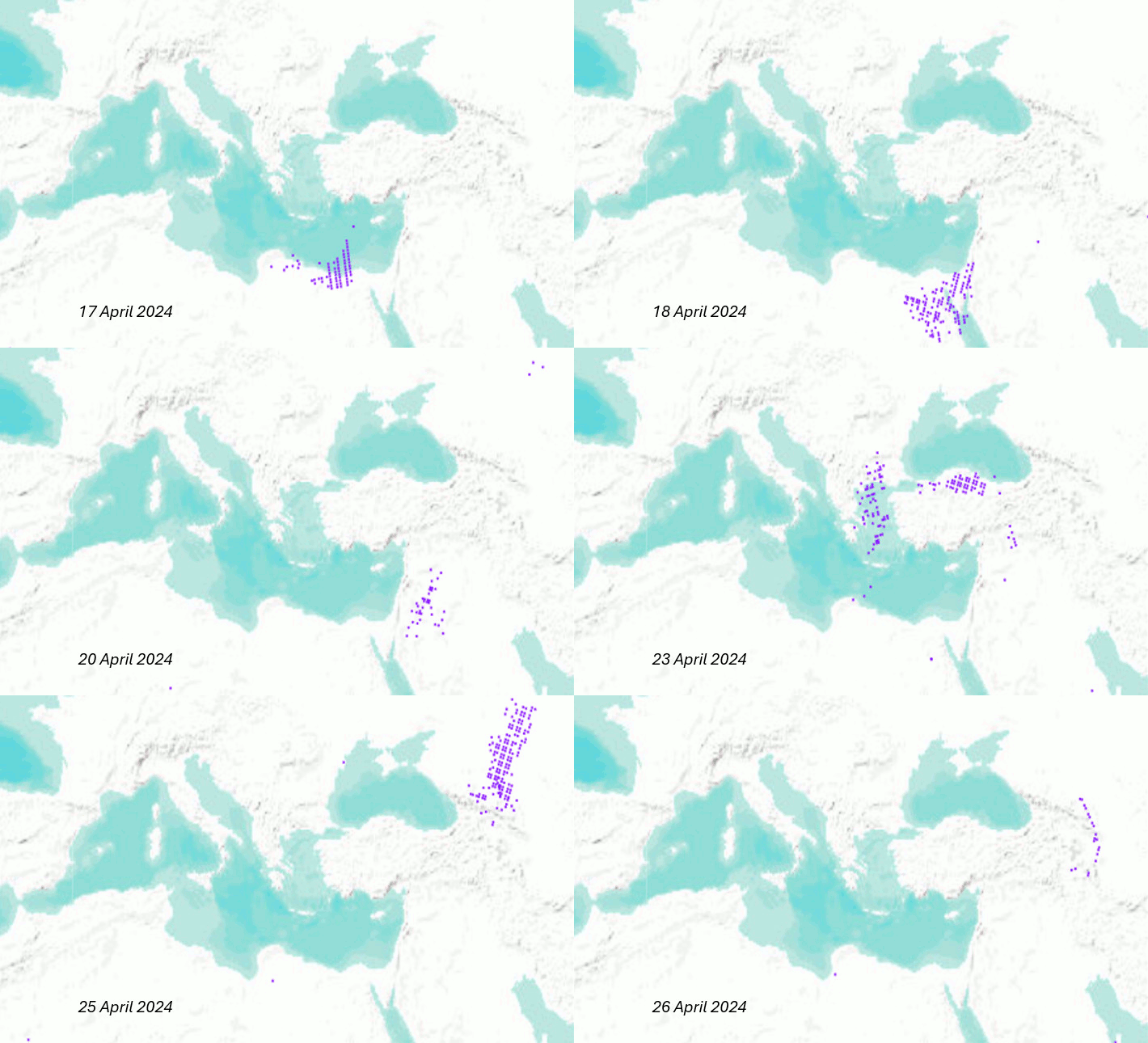
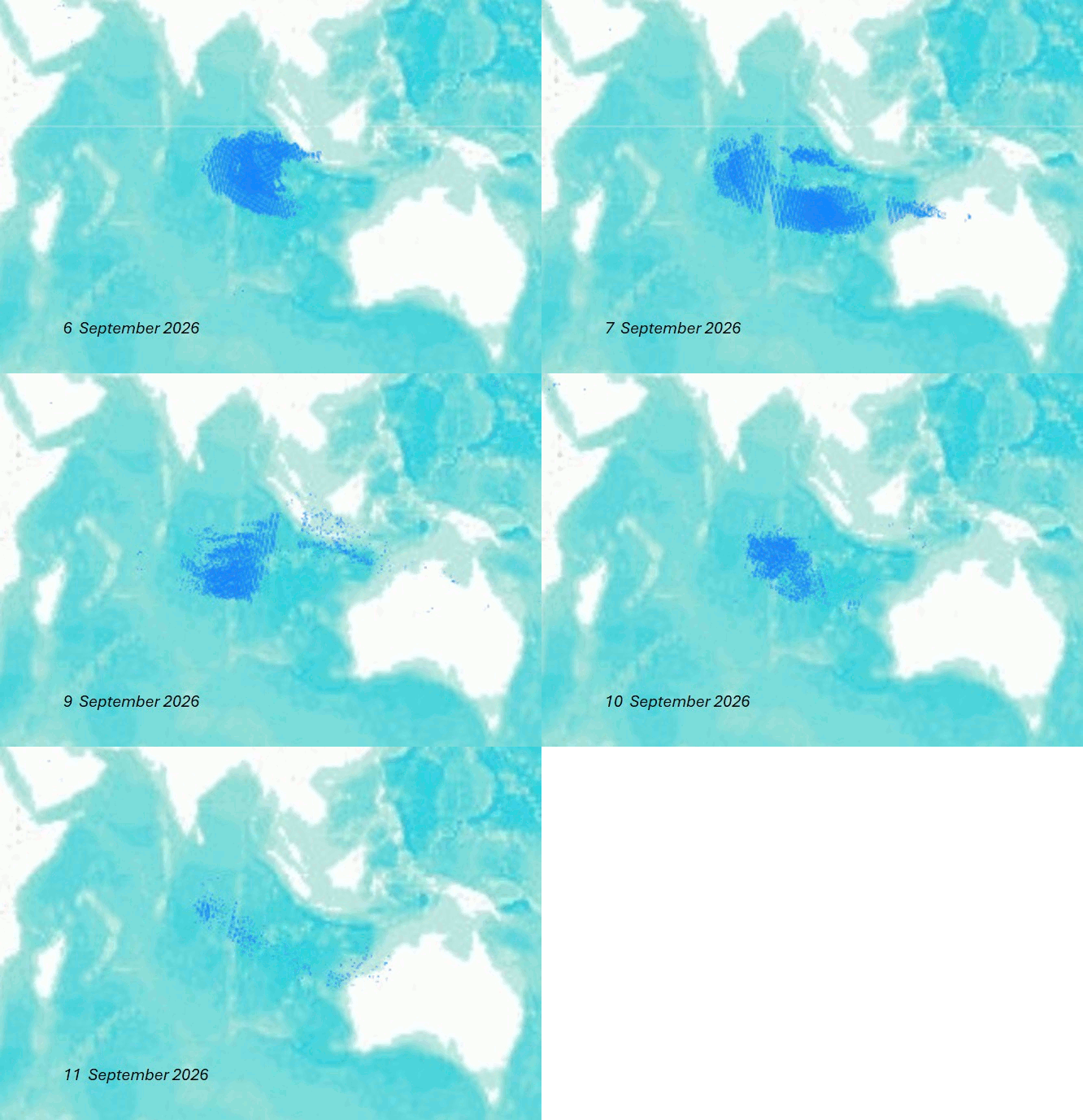
The performance of the PCA-based detection method has been demonstrated for a large variety of atmospheric events. Vu Van et al. (2023) have proven the relevance of the IASI-PCA approach for the detection of volcanic eruptions. In Pipien et al. (2026), authors show uses cases and statistical analysis of wildfire and dust plumes detection. They also present the framework of an operational processing chain able to deliver a robust and confident first-level characterization of the detected events, suitable for routine monitoring and for rapid user access. Now, the IASI-PCA software is deployed on the ICARE infrastructure. The resulting products are available through the AERIS / ICARE data portal. Furthermore, users can perform the detection of species of interest via the interactive tool available on the ICARE visualisation portal. Below two examples: detection of calcite and detection of sulphur dioxide.
Achievement of a long-term fruitful collaboration
This work is a great achievement of a longstanding cooperation between HYGEOS and SPASCIA. Originally, SPASCIA was the expert in the IASI instrument, thermal infrared measurements, and spectroscopic aspects related to the detection of atmospheric species. HYGEOS contributed its expertise in the analysis of satellite measurements, the development of scientific algorithms, the industrialization of prototypes, as well as its capabilities for processing large volumes of data. Over the years, the collaboration has evolved toward an almost equal workload distribution between the two partners. Thus, HYGEOS has played a significant role to improving the detection method, in particular through the selection and filtering of the reference database of IASI spectra, the consideration of instrumental noise, species detection, and event classification.
For more than 10 years now, both companies are aligned with their core values of collaboration, transparency and equity. Their collaboration is continuing to develop and expand atmospheric composition monitoring capabilities, both through the extension of PCA to the solar spectral range using Sentinel-5P and through the exploitation of the enhanced spectral capabilities of IASI-NG to investigate the detection of additional atmospheric species.